
Automation Safety Solutions for Machine Applications
Connect Safety Requirements to Practical Product Solutions.
Scott Equipment Company helps manufacturers, OEMs, machine builders, and integrators review automation safety applications — from machine guarding, safety fencing, interlocks, E-stops, light curtains, scanners, relays, controls, signaling, wiring, and connectivity to the supporting components needed to complete the solution.
Automation Safety Focus Areas
Safety Starts with the Application
Automation safety is more than adding a light curtain or E-stop.
A complete safety approach has to consider how people interact with the equipment, where hazards exist, how quickly the machine can stop, what energy needs to be controlled, and what devices are required to support the safety function.
Scott Equipment Company helps customers review automation safety applications from a practical product and implementation standpoint. Our team supports machine guarding, interlocks, light curtains, safety scanners, E-stops, safety relays, signaling devices, wiring, connectivity, and related automation products that help bring safety requirements into the real world.
Scott Equipment’s Role
We do not perform formal machine risk assessments or certify safety systems.
Our value is helping customers take the results of a safety review, risk assessment, or internal machine safety requirement and identify product options that support the application.
Start with the Safety Requirements
The safety device should match the hazard, access point, and machine behavior.
Before selecting a light curtain, safety scanner, interlock, or E-stop, the customer needs to understand what hazard is being protected, how the machine should respond, and what level of safety is required.
Hazard Location
Where can the operator, technician, or maintenance team be exposed to hazardous motion, pressure, energy, or machine access?
Access Method
Does the application require fixed guarding, an access door, a locking gate, a light curtain, a scanner, or a combination of devices?
Stopping Time
Can the machine stop before someone reaches the hazard, or does access need to remain locked until the hazard is controlled?
Supporting Components
What relays, controllers, reset buttons, cables, brackets, valves, signaling devices, and accessories are needed to complete the application?
Machine Guarding & Safety Fencing
Reduce exposure before relying on electronic safety devices.
In many machine applications, the best first step is to physically separate people from hazardous motion, moving parts, robot cells, conveyors, or automated work areas. Guarding can reduce the number of places where people can reach the hazard and help define the controlled access points where safety devices are needed.
Scott Equipment Company can help customers review guarded areas of an automation cell and support the products needed to create practical barriers around the machine. We support custom aluminum extrusion safety fencing through Frameworld, as well as SATECH machine guarding and safety fencing offered through Schmersal.
This gives customers options for fixed guarding, modular fencing, doors, panels, machine frames, workstations, and guarding structures that can be built around the way the machine is actually used.
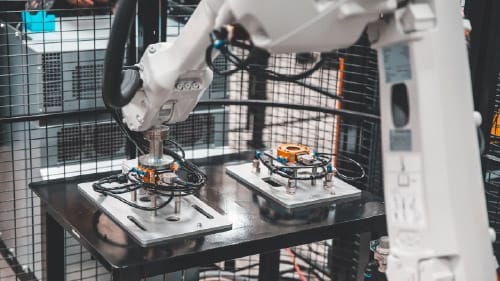
Robot cell with Safety Fencing
More Than Stopping Motion
A machine that has stopped moving is not always safe.
Many automation systems still contain stored energy after visible motion stops. Pneumatic pressure, hydraulic pressure, electrical energy, gravity, spring force, and mechanical momentum can all create hazards if they are not controlled as part of the safety function.
Scott Equipment Company works across pneumatic, electrical, controls, sensing, and machine safety products, which allows our team to help customers think through the supporting components that may be needed around the safety device itself.
Supporting Safety Components May Include:
- Safety relays and controllers
- Pneumatic safety valves and air dump systems
- Door locks and safety interlocks
- Reset stations and request-to-enter controls
- Safety-rated I/O and networked safety products
- SMC locking cylinders for machine safety
Access Control
Interlocks, door locks, and request-to-enter systems help control how people enter the machine area.
Not every machine can be protected with an open access point. If a machine, robot, conveyor, or automated mechanism cannot stop quickly enough, a locking door or controlled access point may be required.
Scott Equipment’s Role
Scott Equipment Company helps customers compare access-control options based on the machine layout, access point, required safety function, and operator workflow. We can support safety interlocks, locking door switches, push-button stations, E-stops, reset buttons, and the related products needed to build a complete access-control point.
Safety Interlocks
Used to monitor doors, gates, panels, and access points where machine motion or hazardous energy must be controlled.
Locking Devices
Help keep access points locked until the machine reaches a safe state or the safety function allows entry.
Request-to-Enter
Allows an operator or maintenance person to request access, let the machine stop properly, and then enter the guarded area.
Presence Sensing
Light curtains and safety scanners help protect access points while keeping production practical.
Light curtains are commonly used where operators load parts, remove finished goods, or interact with machinery. Safety scanners can be a strong option when an application requires area monitoring, warning zones, or flexible protected zones around a machine.
These devices should not be selected by size alone. The application may require a specific resolution, protective height, mounting arrangement, cable set, safety relay, muting function, blanking function, or accessory package.
Scott Equipment Company helps customers review the application and identify presence-sensing options that fit the machine layout and safety requirement, including Datasensing SH4 safety light curtains, other industrial safety light curtains, and safety laser scanners for industrial automation.
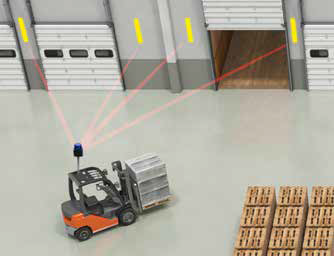
Safety Scanners protect guarded access points
Muting
Allows the safety system to temporarily ignore a light curtain under controlled conditions, such as when a pallet passes through a guarded opening in the correct sequence.
Blanking
Allows specific beams of a light curtain to be ignored when part of the machine, conveyor, fixture, or material consistently blocks those beams.
Warning Zones
Safety scanners can help warn operators before they enter a protected zone, reducing unnecessary machine stops while maintaining awareness around the equipment.
Safety Relays, Controllers & Connectivity
Safety devices need to connect to safety-rated relays, controllers, or safety I/O.
A standard PLC input is not a substitute for a safety-rated device. Safety relays, safety controllers, safety PLCs, and safety I/O are designed to monitor safety inputs and control safety outputs with the redundancy, diagnostics, and response behavior required for safety functions.
Safety Relays
In many applications, a safety relay can provide the required function without the complexity of a full safety PLC. Scott Equipment supports Finder 7S Series modular safety relays for machine safety circuits.
Networked Safety
More advanced applications may require safety-related communication, distributed I/O, or networked safety. Scott Equipment supports Murrelektronik MVK Fusion with CIP Safety.
Safety Integration Support
Scott Equipment can help customers review the safety devices being used and identify compatible relays, controllers, I/O, wiring, and connectivity products to support the application.
Signaling & Operator Awareness
A safety system should communicate clearly with the people around the machine.
Operators and maintenance teams need to know when a machine is running, stopped, faulted, waiting for reset, requesting access, or approaching a safety zone. Visual and audible signaling devices help make machine status easier to understand.
Scott Equipment supports stack lights, signal towers, audible alarms, visual indicators, and PATLITE wireless signaling solutions for industrial automation environments.
Common Signaling Products
- Stack lights
- Signal towers
- Audible alarms
- Wireless signaling
- Status indicators
Maintenance & Troubleshooting Support
The safety system also needs to be practical for the people who maintain the machine.
Automation safety does not end once the machine is running. Maintenance teams need to troubleshoot devices, replace components, reset equipment, and understand why a machine stopped. The easier the system is to understand and maintain, the more practical it becomes for the people responsible for keeping production moving.
Scott Equipment’s Role
Scott Equipment Company helps customers look beyond the main safety device and consider the full package of products needed to install and maintain the application. That includes guarding, controls, pneumatics, sensors, wiring, connectivity, signaling, and replacement components.
Safety Vendors We Support
Automation safety brands and product support from Scott Equipment Company.
Scott Equipment Company represents safety-focused vendors that support machine guarding, access control, presence sensing, safety relays, E-stops, operator controls, signaling, connectivity, and industrial automation safety applications.
Schmersal
Safety switches, interlocks, safety controllers, light curtains, control devices, and machine safety components.
Visit SchmersalSATECH Guarding
SATECH machine guarding and safety fencing systems offered through Schmersal.
View SATECH GuardingEuchner
Safety interlocks, door locking systems, enabling switches, access control products, and machine safety devices.
Visit EuchnerFrameworld
Aluminum extrusion safety fencing, machine guarding, custom frames, workstations, and guarding structures.
Visit FrameworldDatasensing
Safety light curtains, safety laser scanners, area sensors, LiDAR, and sensing technologies for industrial automation.
Visit DatasensingFinder
Safety relays, industrial relays, timers, monitoring relays, and control components used in automation panels.
Visit FinderBaco Controls
E-stops, push buttons, selector switches, pilot devices, and customized operator-control products.
Visit Baco ControlsPATLITE
Stack lights, signal towers, audible alarms, visual indicators, and wireless signaling products.
Visit PATLITEMurrelektronik
Industrial connectivity, machine I/O, safety-related networking products, fieldbus modules, and CIP Safety solutions.
Visit MurrelektronikBringing Safety Products Together
Scott Equipment helps customers bring these technologies together by supporting the safety devices, guarding, relays, operator controls, signaling, wiring, and connectivity products needed to complete the application.
Automation Safety FAQ
Common questions about automation safety products and application support.
Machine safety applications can include guarding, access control, presence sensing, safety relays, signaling, wiring, and connectivity. These questions help explain how Scott Equipment Company supports customers after safety requirements are defined.
Does Scott Equipment Company perform machine safety risk assessments?
Scott Equipment Company does not perform formal machine safety risk assessments or certify machines as safe. Our role is to help customers review the application from a product and implementation standpoint after safety requirements are defined by the customer, a qualified safety professional, or a formal risk assessment.
What automation safety products does Scott Equipment support?
Scott Equipment supports machine guarding, safety fencing, safety interlocks, door locks, E-stops, push buttons, light curtains, safety scanners, safety relays, safety I/O, signaling devices, wiring, connectivity, and related industrial automation safety components.
When should a machine use safety fencing instead of a light curtain or scanner?
Safety fencing and fixed guarding are often used to physically separate people from hazardous motion or machine access areas. Light curtains and safety scanners are commonly used where operators or products need controlled access through a guarded opening. Scott Equipment can help customers compare product options based on the machine layout and defined safety requirements.
What is the difference between a light curtain and a safety scanner?
A light curtain typically protects an access point by creating a defined sensing field between a transmitter and receiver. A safety scanner monitors an area and can support protected zones, warning zones, and flexible layouts. The right choice depends on access needs, machine layout, stopping time, product flow, and the required safety function.
Can Scott Equipment help with safety relays, safety I/O, and connectivity?
Yes. Scott Equipment can help customers review safety devices and identify supporting relays, controllers, safety I/O, wiring, and connectivity products. This can include safety relays for simpler machine safety circuits as well as networked safety products for more advanced automation systems.
Why are E-stops, interlocks, and reset stations important in machine safety?
Everyday safety devices are often the components operators and maintenance teams interact with most. E-stops, interlocks, safety switches, reset stations, and push buttons help support access control, machine stops, restart procedures, and operator communication around the equipment.
Review Your Automation Safety Application
Need help matching safety components to your machine or automation cell?
Contact Scott Equipment Company to discuss machine guarding, safety relays, light curtains, scanners, interlocks, E-stops, signaling, connectivity, and related industrial automation safety products.
Contact Scott Equipment CompanyScott Equipment Company provides trusted automation solutions and application support for manufacturers throughout North and South Carolina.
Trusted Automation Solutions for the Carolinas Since 1977.