
Shock Absorbers
Industrial hydraulic shock absorbers bring moving loads to a smooth, controlled stop. Motion applied to the piston forces fluid through restricting orifices, turning the load's kinetic energy into heat that the shock absorber body dissipates harmlessly. Rubber bumpers and springs store most of the energy and return it as rebound, and cylinder cushions have short strokes and little capacity; a shock absorber gives controlled, predictable deceleration instead.
We carry the Enidine range: adjustable, non-adjustable and heavy duty shock absorbers, rate controls, wire rope isolators, air springs, and the accessories to mount them.
Shop by Category
-
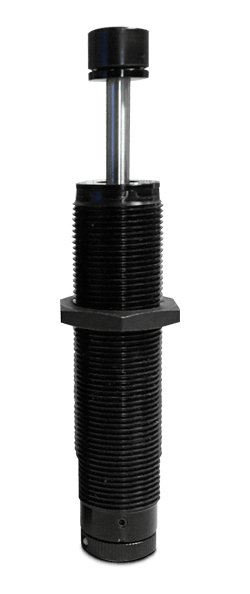 Adjustable Shock Absorbers
Turn the adjustment knob to tune the damping force where input conditions vary or are not clearly defined. ECO OEM, OEMXT and OEM large bore series.
Shop adjustable shock absorbers ›
-
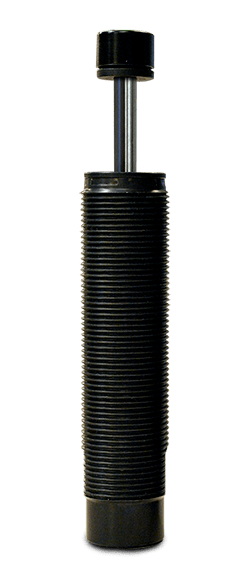 Non-Adjustable Shock Absorbers
Tamperproof units that give consistent performance cycle after cycle and absorb maximum energy in a compact envelope. ECO, PMXT, PRO 110, HP 110 and TK series.
Shop non-adjustable shock absorbers ›
-
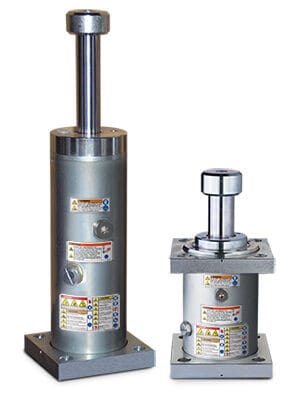 Heavy Duty Shock Absorbers
HDN and HDA large-bore shock absorbers for large impacts, such as automated storage and retrieval systems and overhead bridge and trolley cranes.
Shop heavy duty shock absorbers ›
-
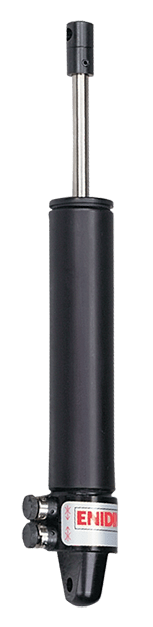 Rate Controls
Regulate the speed or time a mechanism takes to move: ADA 500 and ADA 700 adjustable, double acting rate controls, and viscous speed governors for rotary motion.
Shop rate controls ›
-
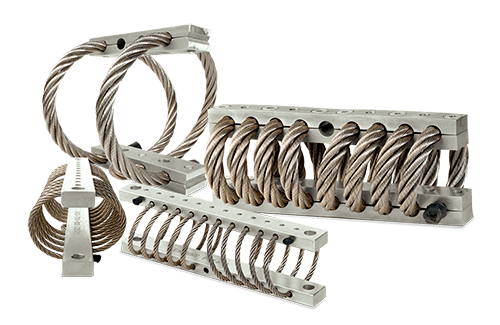 Vibration Isolation
Wire rope and compact wire rope isolators with stainless steel cable and aluminum retaining bars, for shock and vibration isolation.
Shop vibration isolation ›
-
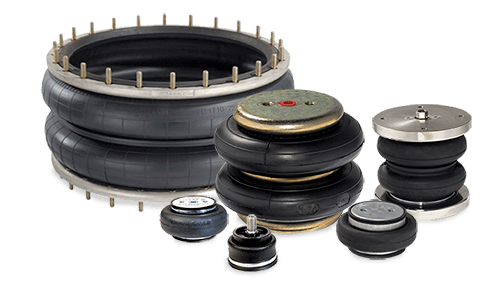 Air Springs & Bumpers
Single, double and triple convolute bellows, sleeve and rolling lobe air springs, for actuation and vibration isolation.
Shop air springs & bumpers ›
-
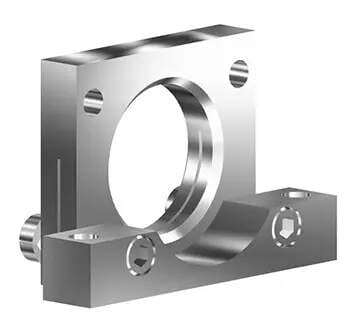 Accessories
Jam nuts, stop collars, lock rings, flanges, foot mounts, side load adaptors and urethane striker caps to mount and protect a shock absorber.
Shop accessories ›
Why Use an Industrial Shock Absorber
- Longer machine lifeLess shock and vibration reaching the machine means less damage, less downtime and lower maintenance costs.
- Higher operating speedsMoving loads are stopped gently and under control, so machines can run faster and production rates can rise.
- Better production qualityNoise, vibration and damaging impacts are reduced or eliminated, so tolerances and fits are easier to hold.
- Safer operationPredictable, reliable, controlled deceleration protects both the equipment and the people operating it.
Adjustable or Non-Adjustable?
Adjustable
Best where input conditions vary or are not clearly defined. Turning the adjustment knob changes the damping force, so one model can be tuned to a wide range of conditions. Set the knob at 0, cycle the machine, and raise the setting gradually until the load stops smoothly without banging at the end of the stroke.
Shop adjustable shock absorbers ›Non-Adjustable
Best where the application is known and repeatable. Tamperproof units give consistent performance cycle after cycle and absorb maximum energy within a compact envelope. The ECO series covers a wide range of conditions, from low velocity with high drive force to high velocity with low drive force.
Shop non-adjustable shock absorbers ›Sizing a Shock Absorber
A shock absorber is selected on energy, not just size. To size one, these must be known:
- Weight of the load to be stopped (lbs or kg).
- Impact velocity of the load when it reaches the shock absorber (in/sec or m/s).
- Propelling force any external force still driving the load, such as cylinder thrust or motor drive force, if there is one.
- Cycle rate how many times per hour the shock absorber will operate.
- Orientation horizontal, vertical up or down, inclined, or rotary. For rotary motion, also the moment of inertia, angular velocity and torque.
From these come the energy per cycle, the work done by any propelling force, and the energy per hour the unit must dissipate as heat. The model chosen must exceed all three and must be rated for the propelling force. Contact us with your application details for help selecting a model.